Category: Campaign News

  • Death Valley, a 9-1 Wake, and Why November Still Matters

    Rankings are the Nov. 10 CFP board, unless noted.

    Arch Manning found Raleek Brown for a 4-yard touchdown with three seconds left, and No. 6 Texas escaped Death Valley with a 22-21 win over No. 21 LSU. No. 2 Utah stayed unbeaten, 40-39, on a 70-yard strike with 2:35 to play. Indiana beat No. 18 USC 27-13 for its first win ever over the Trojans, to go 9-1. And 9-1 Wake Forest hung 49 on No. 25 AP SMU.

    That is what a loss is still allowed to cost. Earn it in November.

    The CFP already approved a 24-team playoff for 2027–28. We can still tell the truth about Saturday under 12, and what a doubled field would probably soften.

    When a Saturday still has teeth

    Death Valley was a pick-fest. Manning and LSU’s Sam Leavitt each threw three interceptions. Texas defensive back Jelani McDonald had three of them, and Lane Kiffin fell to his knees after Leavitt’s third. Then Manning, down 21-16, drove 58 yards and won it at the gun. Texas is 8-2 and still in the 12-team hunt. LSU is 6-4. In a 24-team field, that fourth November loss would likely have been about seeding, not survival.

    Utah had to go get it on the road. Devon Dampier hit Creed Whittemore for 70 yards, and the Utes improved to 10-0. Arizona fell to 7-3. In a 24-team bracket, a 7-3 power-conference team would probably already have a seat.

    Grant Wilson, in his first start for Indiana, threw for 305 yards and two scores. CBS Sports’ Tom Fornelli said USC is out of playoff contention. A 7-3 USC team, under 24, would likely still be in the hunt. Under 12, that loss closes a door.

    Earn it in November

    Wake Forest left no doubt, leading 42-0 at halftime and beating SMU 49-7. They entered the week at No. 13, just outside the field. CBS Sports’ RJ Young asked: “If the committee does not have Wake Forest in its top 12 on Tuesday, what are we doing?” In a 24-team world, a 9-1 Wake Forest team would probably already be comfortably inside the bracket.

    Clay Travis put the Iron Bowl in plain language: if Alabama lost to Auburn, a 9-3 Tide “would be on playoff ropes and need help.” Alabama is 8-2 after beating Vanderbilt, with Chattanooga and Auburn still to play. In a 24-team world, a 9-3 Alabama would probably stroll in anyway, and the Iron Bowl would be a seeding game.

    Fans were not asking for 24. The Athletic survey found 70% of fans oppose a 24-team playoff. We can’t un-approve 2027–28. We can still defend this November. Follow @SaveCollegeFB. Share this. Take action. And keep saying it: earn it in November.

  • When the Schedule Breaks: Friday’s Ground Stop and a 24-Team Playoff

    When the Schedule Breaks: Friday’s Ground Stop and a 24-Team Playoff

    On Friday afternoon, the FAA issued a nationwide ground stop for all U.S. airports after communication issues hit multiple air traffic control centers. College football did not cause it. But within hours, it was rewriting the weekend.

    Ole Miss could not leave Oxford Friday night, and its charter could not take a late-night departure once the stop lifted. So the SEC moved No. 19 Ole Miss at Oklahoma to Sunday at noon Central. Oklahoma athletic director Roger Denny said commissioner Greg Sankey made that call “over our strong objection,” warned that not playing Sunday would mean a forfeit, and wrote that the decision “isn’t fair to our athletes, our institution or to Sooner Nation,” in the school’s statement.

    It wasn’t the only change. No. 2 Utah at No. 23 Arizona moved from 7:30 to 10:30 p.m. ET. Baylor at No. 10 BYU, Arizona State at UCF, Washington at Michigan State and several other games got new kickoff times.

    Today still counts, because we’re at 12

    Ranks are from the CFP’s Nov. 10 rankings. All times ET.

    • No. 3 Alabama at Vanderbilt, 12:45 p.m., SEC Network
    • No. 8 Tennessee at Texas A&M, 3 p.m., ESPN
    • No. 22 Missouri at No. 1 Georgia, 3:30 p.m., ABC
    • No. 18 USC at No. 9 Indiana, 3:30 p.m., CBS
    • No. 6 Texas at No. 21 LSU, 7:30 p.m., ABC
    • No. 12 Texas Tech at No. 25 Oklahoma State, 9:30 p.m., ESPN
    • No. 2 Utah at No. 23 Arizona, 10:30 p.m., FOX
    • No. 19 Ole Miss at Oklahoma, Sunday, 1 p.m. (TV to be announced)

    At 12, an upset still costs a team its seat. At 24, several of these visitors would already be in on Tuesday’s board.

    What 24 adds to a brittle calendar

    The format the CFP approved for 2027–28 has 23 playoff games, and 16 of them will be on campus, up from four. The first two rounds are played Thursday through Saturday. The regular season ends Nov. 27, and the playoff begins the first full week of December. That means more teams booking more charters on short notice, in December weather.

    At the same time, the SEC, Big Ten and ACC have said this year’s title games will be their last annual ones. Losing Championship Saturday doesn’t just cost fans a tradition. It also takes away a familiar weekend before a bigger, more travel-heavy playoff.

    One Friday outage just pushed a ranked game to Sunday and put a forfeit on the table. What happens when 16 campus playoff games depend on last-minute flights? Who answers for players told to play on a new day, or else? Who answers for fans holding Saturday tickets and hotel rooms?

    Those aren’t predictions. They’re questions the people who approved 24 should have to answer. Take action and share #SaveCollegeFootball.

  • If 24 Started This Year — What Tuesday’s Rankings Show

    If 24 Started This Year — What Tuesday’s Rankings Show

    Rankings in this post are the CFP Selection Committee’s second rankings, released Nov. 10, 2026, as of games through Nov. 7.

    Tuesday night, the College Football Playoff Selection Committee put Georgia at No. 1 and Utah at No. 2. If those same rankings were a 24-team field, here is who would already be in: Ohio State at No. 20, after falling eight spots and losing two straight. Kentucky, which dropped from No. 6 to No. 11 after a 34-6 loss to Tennessee. A 6-3 LSU team at No. 21.

    That is the format the CFP approved on Nov. 9 for 2027–28. That is why we opposed it. And that is why this Saturday still matters — because this season is still 12.

    If 24 started this year

    This is a snapshot, not a finished bracket. Rankings will move between now and Selection Day, and the 24-team field is not simply the top 24: it is four conference champions, the highest-ranked Group of 6 team, and the 19 highest-ranked remaining teams. But Tuesday’s official board is the clearest picture we have of who a doubled field would reward right now.

    Look down the list. From No. 13 Wake Forest through No. 24 Boise State, twelve teams sit outside today’s top 12. Several of them are 6-3. In a 24-team playoff, they would already have a seat on this board. In this year’s 12-team playoff, they are still playing for one.

    Of those 24 teams, nine are from the SEC and six are from the Big Ten. Only one, Boise State at No. 24, is from a Group of 6 conference.

    Ohio State, 12 to 20

    The Buckeyes entered last week at No. 12, on the cut line. They lost to Oregon 41-28, their second straight defeat after USC beat them 30-18 on Halloween. The committee dropped them eight spots, to No. 20, at 6-3.

    In a 12-team field, that is a free fall. Two straight losses put a traditional power outside the picture and force the rest of the season to answer for it. In a 24-team field, Ohio State at No. 20 is still in. The losses would have cost seeding, not a place in the tournament.

    Kentucky, 6 to 11

    Kentucky came into Week 10 at No. 6, its highest CFP ranking ever, and left with a 34-6 loss to Tennessee. The committee dropped the Wildcats five spots, to No. 11. They are 7-2 and still inside today’s top 12 — barely.

    That is the 12-team point. A blowout loss moved them from comfortable to the edge. Another bad Saturday, and they could fall out. In a 24-team field, a drop from 6 to 11 is a seed change. The Wildcats would still be comfortably inside the field. The loss would barely threaten their place.

    LSU, 14 to 21

    LSU lost at home to Alabama, 31-13, and fell from No. 14 to No. 21 at 6-3. Under 12, that third loss puts them well outside the field. Under 24, a 6-3 LSU at 21 is already in on this board.

    Pat Forde made a similar case in Sports Illustrated on Wednesday, applying the new 24-team format to this same board. We do not need his column to see it. The arithmetic is sitting on the CFP’s own list.

    This Saturday still counts — because we’re at 12

    This year’s tournament stays at 12. That is why Saturday, Nov. 14, still has teeth. Kickoffs and networks are per the NCAA.com TV schedule. All times are ET.

    • No. 18 USC at No. 9 Indiana, 3:30 p.m., CBS. Indiana is 8-1 and sitting in the field. USC is 7-2 and sitting at 18, looking up. A Trojan win would mean something real in a 12-team race. In 24, USC would already be in on this board.
    • No. 6 Texas at No. 21 LSU, 7:30 p.m., ABC. For LSU, this is a chance to climb back into the conversation. In a 24-team field, the Tigers would already be inside today’s 24. The desperation that makes a night in Baton Rouge feel huge comes from how few spots there are.
    • No. 2 Utah at No. 23 Arizona, 7:30 p.m., FOX. Utah is 9-0, one of two unbeaten teams left. Arizona is 7-2. At 24, Arizona is already in the field on this board. At 12, an upset would scramble the top and give the Wildcats a real argument. That is the difference.

    Oregon is the other reminder. The Ducks jumped seven spots, from No. 23 to No. 16, after beating Ohio State. They are still outside the top 12. A signature November win moved them — and they still have work to do. That is what 12 does. It rewards you, and then it asks for more.

    What we fight for now

    The CFP already approved 24 for 2027–28. We cannot undo Monday’s vote. We can still insist that this year’s regular season is watched and defended for what it is, and that decision-makers answer for what they approved.

    Protect November. Protect a field small enough that a loss costs you something. Tell your conference, your school, and the CFP that fans opposed 24 and still want a regular season that decides something.

    Take action with updated scripts and links. Share #SaveCollegeFootball. Saturday still matters. Keep it that way.

  • What Monday’s Announcement Means — and What We Fight for Now

    Updated Nov. 9, 2026, after the CFP’s official expansion announcement.

    Monday morning, the College Football Playoff Management Committee unanimously approved expanding the playoff to 24 teams, beginning with the 2027–28 season. The CFP also announced a new exclusive media rights agreement with ESPN for the expanded format through the 2031–32 season. Financial terms were not disclosed. This year’s tournament, 2026–27, stays at 12 teams.

    We opposed that decision. We still do. The vote does not make us wrong about what fans want from Saturdays in November. It does mean the campaign has to change how we fight.

    What was decided (official)

    Per the CFP Nov. 9 release and fact sheet:

    • The field is 24 teams: the four conference champions from the ACC, Big Ten, Big 12 and SEC (as each conference determines); the highest-ranked team from the American, Conference USA, MAC, Mountain West, Pac-12 or Sun Belt; and the 19 highest-ranked remaining teams.
    • Seeds 1–8 get a first-round bye and host second-round games on campus. Seeds 9–16 host first-round games against seeds 17–24. Sixteen of 23 playoff games will be on campus, up from four in the 12-team format.
    • Quarterfinals and semifinals stay at the Cotton, Fiesta, Orange, Peach, Rose and Sugar bowls.
    • The CFP adopted scheduling standards meant to push more compelling non-conference games. Autonomy 4 and Group of 6 schools are expected to play at least 10 qualifying regular-season games under those rules. Selection Day timing will be announced later.
    • In 2027–28, the regular season ends Saturday, Nov. 27, 2027, and the playoff begins the first full week of December. No CFP games will conflict with Army–Navy.
    • On conference championship games, the CFP fact sheet says decisions “rest with each conference.”

    The CFP’s own statement said the decision was driven by a desire to “increase opportunities for FBS programs, student-athletes and fan bases” while using scheduling standards to incentivize tougher non-conference games. Executive Director Rich Clark pledged to “make the 24-team Playoff spectacular.” Those are their words. Fans get to decide whether access is worth the trade.

    What conferences decided the same day

    Separately from the CFP vote, three Power conferences said their 2026 football championship games will be their last annual ones: the SEC, the Big Ten and the ACC. Those are conference announcements, not a line in the CFP expansion vote. The ACC said it will work with members and the CFP on how to identify its champion going forward. The Big Ten said it is finalizing how it will determine its football champion in future seasons.

    That matters. Championship Saturday was never a CFP product. Conferences built it, sold it and, in three cases Monday, chose to end the annual version. Fans who love those games still have someone to call.

    What we are not claiming

    We are not saying Monday’s vote can be casually undone. It was unanimous, and it comes with a multi-year ESPN rights deal running through 2031–32. We are not inventing dollar figures. Outlets have reported added rights fees; the CFP release says financial terms were not disclosed, so we will stick to that. And we are not pretending a December 1 campaign deadline was still a window to stop the announcement. That window closed Monday.

    Why we opposed 24 — and still do

    The case has not changed. More spots make more losses survivable. That softens November. We laid it out before the vote on our Stop the 24-Team Playoff page and in 12 vs. 24 Teams. Even Nick Saban, who floated 16 as a possible compromise, said there are “not 24 teams in the country that can win the National Championship” and asked what the reason to do it is.

    Officials will sell access. We get the argument. Twelve already gave conference champions and at-large teams a path. Doubling the field is not the only way to include more programs. Background on what was confirmed before Monday is still useful on What Is the 24-Team College Football Playoff Proposal? — read it with the Nov. 9 update that the proposal is no longer pending.

    What we fight for now

    The new fight is accountability:

    • Protect Championship Saturday where it still can be saved. Tell conferences that ending annual title games is a choice, not destiny. If your league has not closed the door, say so now.
    • Demand a regular season that still decides something. Seeding, byes and home games should reward tough schedules and tough November wins. Scheduling standards on paper mean nothing if soft games still get rewarded.
    • Insist on transparency. Fans deserve clear answers on money, player workload across 23 playoff games, and how those scheduling standards will actually be enforced.
    • Keep this year’s 12-team race honest. 2026–27 is still a 12-team playoff. Every Saturday still counts. Watch it like it matters, because it does.

    Your next move

    Anger without a target fades. Pick one: your conference office, your school president or athletic director, or the CFP through its public staff contacts. Tell them you opposed 24, you still want Championship Saturday, and you want November to hurt when a team loses.

    Take action with updated scripts and links. Share #SaveCollegeFootball. We lost the vote. We have not lost the sport, and we are not done.

  • No. 1 Fell, Kentucky Crashed, Utah Survived: Why Saturday Proved 12 Is Enough

    No. 1 Fell, Kentucky Crashed, Utah Survived: Why Saturday Proved 12 Is Enough

    Rankings in this post are the CFP Selection Committee’s first rankings, released Nov. 3, 2026. Scores and details link to the game recaps.

    We called it in our Week 10 preview: seven games between CFP-ranked teams, and every one with something real at stake. Saturday delivered. The No. 1 team lost. An undefeated team stayed perfect in a rivalry game. Kentucky, coming off its highest CFP ranking ever, lost by 28. And traditional power Ohio State lost its second straight. By midnight the top of the playoff picture looked different than it did at breakfast.

    That’s what a 12-team playoff does to November. Here’s what happened, and why it matters for the fight over a 24-team field.

    The results

    No. 11 Notre Dame 31, No. 1 Miami 24

    Notre Dame built a 24-3 lead in the third quarter behind three CJ Carr touchdown passes, then held on as Darien Mensah threw three second-half touchdowns for Miami. The game turned on a single snap. On fourth-and-6 from the Notre Dame 18, Mensah found tight end Eli Lofton in the corner of the end zone, but Lofton couldn’t hold the ball. Miami turned it over on downs with 3:36 left, and a last-second hook-and-ladder fell short. Both teams are now 8-1. Miami had been No. 1 in the CFP rankings for the first time in program history.

    No. 2 Georgia 42, No. 10 Ole Miss 7

    Georgia led 28-0 at halftime in Oxford and held Ole Miss quarterback Trinidad Chambliss to 69 first-half passing yards.

    No. 3 Utah 28, No. 9 BYU 20

    Utah won the Holy War 28-20 and stayed unbeaten. After Miami’s loss, Utah and UCLA are the only teams left with no losses. BYU still has one loss, and that loss came against a ranked rival, so NCAA.com’s analysts even raised whether BYU’s head-to-head win over Notre Dame could keep it in the mix.

    No. 13 Tennessee 34, No. 6 Kentucky 6

    Tennessee led only 13-6 after three quarters, then scored three fourth-quarter touchdowns. Its defense forced three turnovers, held Kentucky to 0-for-2 on fourth down and kept the Wildcats out of the end zone. Kentucky came in at No. 6, its highest CFP ranking ever, sitting atop the SEC and riding a six-game winning streak. It leaves at 7-2. It was Tennessee’s second straight home win over a top-10 team.

    No. 5 Alabama 31, No. 14 LSU 13

    Alabama pulled away in Baton Rouge. Keelon Russell went 17-for-24 for 206 yards and three touchdowns. LSU, 6-2 entering the night, now has a third loss.

    Also: Oregon 41, Ohio State 28, and Texas 34, Missouri 20

    No. 23 Oregon scored 38 unanswered points after falling behind 14-0 to beat No. 12 Ohio State. The Buckeyes, still without starting quarterback Julian Sayin, have now lost two straight. No. 7 Texas beat No. 18 Missouri 34-20, its third straight win and fourth against ranked opponents this season.

    Why yesterday mattered

    Look at what each of these games did. Notre Dame came in with one loss and a lot to prove. Now it owns a win over the No. 1 team, and its whole season looks different. Kentucky was a feel-good story at No. 6, and one bad night against a rival put that place in doubt. LSU and Ole Miss each took a costly loss. Ohio State is suddenly fighting just to stay relevant.

    We are not declaring any team’s playoff hopes over. The committee will sort it out. But for the teams that lost, there is now less room for error, and that’s the point. In a 12-team field, a November loss has to be answered on the field. You win out and hope for help, or you hope the committee values your resume more than the next team’s.

    Our view: double the field, and much of that pressure fades. We can’t say exactly how any of yesterday’s teams would be treated under a 24-team format, because no format has been officially announced. But it’s simple arithmetic that the more spots there are, the more room a two- or three-loss contender has. In our view, the pressure that made games like Alabama–LSU and Tennessee–Kentucky feel so big comes from how much a loss can cost. A bigger field would ease that pressure.

    The best argument for 24, and our answer

    The strongest case for expansion is access. More teams get a shot, and fewer good teams get left out after a close call. Depending on the final format, more fan bases might also get postseason games. That’s a real argument, and plenty of fans who love the sport make it.

    Our answer: 12 already gives access. Under the CFP’s official format, the field is the five highest-ranked conference champions plus the next seven highest-ranked teams. Yesterday showed a team can lose a game and still play its way back, which is exactly what Notre Dame is trying to do. What 12 doesn’t do is make the regular season optional. Even Nick Saban, who has floated 16 as a possible compromise, told the New Heights podcast: “There’s not 24 teams in the country that can win the National Championship. So, what is the reason to actually do it?”

    For the full side-by-side, read 12 vs. 24 Teams: What CFP Expansion Changes.

    Where expansion stands right now

    On Nov. 6, the CFP said a formal agreement with ESPN on future media rights “in connection with potential expansion” is “in the final stages of review,” and that “a decision on the agreement will be made following this review.” That’s a review of a TV deal, not an announced 24-team format. Back in September, the CFP said opening those talks “does not represent a decision or commitment to expand.” Reports of how a 24-team bracket might work are still reports. Our explainer What Is the 24-Team College Football Playoff Proposal? keeps track of what’s confirmed and what isn’t.

    Your move

    Yesterday was a reminder of what we stand to lose: a national title race decided on the field one Saturday at a time. If you felt it, say so. Read the full case against a 24-team playoff, then take action and contact decision-makers before the campaign’s December 1 deadline. Keep it at 12.


  • Week 10 Preview: Seven Ranked Matchups, and Why 12 Makes Them Matter

    Week 10 Preview: Seven Ranked Matchups, and Why 12 Makes Them Matter

    Rankings are from the first CFP Selection Committee rankings, released Nov. 3, 2026. Kickoffs and networks are per the CFP’s Week 10 preview. All times are ET, Saturday, Nov. 7.

    This is what November is for. The College Football Playoff’s own Week 10 preview counts seven games between CFP-ranked teams this Saturday, two of them top-10 matchups. Every one of them matters because the field is only 12 teams. A loss today doesn’t automatically end anyone’s season. But with a 12-team field it costs something real, and that’s the point.

    The five games we’re watching

    • No. 9 BYU at No. 3 Utah, 12 p.m. ET, ABC. A rivalry and a top-10 game. Utah (8-0) is one of three undefeated teams left. BYU (7-1) has won three straight in the series.
    • No. 5 Alabama at No. 14 LSU, 3:30 p.m. ET, ABC. Two 6-2 teams in Death Valley. One of them leaves with a third loss.
    • No. 6 Kentucky at No. 13 Tennessee, 6:15 p.m. ET, ESPN. Kentucky (7-1) has its highest CFP ranking ever. Tennessee (6-2) needs a statement win.
    • No. 1 Miami at No. 11 Notre Dame, 7:30 p.m. ET, NBC. Miami (8-0) is No. 1 for the first time in program history. Notre Dame (7-1) was the first team out last year.
    • No. 2 Georgia at No. 10 Ole Miss, 7:30 p.m. ET, ABC. Georgia (7-1) faces a tough November. Two-loss Ole Miss (6-2) can make a big move.

    Also on the slate: No. 7 Texas vs. No. 18 Missouri (12 p.m. ET, ESPN) and No. 23 Oregon at No. 12 Ohio State (3:30 p.m. ET, CBS). Rankings and records: CFP rankings, Nov. 3. Matchups, kickoffs and networks: CFP Week 10 preview.

    Why a 12-team field makes today matter

    Picture Alabama-LSU in a 24-team world. A larger field could give the loser more room to recover from a third loss. We think that would take some of the edge off a game fans should be nervous about. With 12 spots, a third loss puts more pressure on the rest of a team’s résumé. Tennessee and Ole Miss face that same pressure today. None of these games settles anything by itself, and committee rankings can move a lot between now and Selection Day. That uncertainty is exactly why every snap matters.

    Doubling the field would turn a Saturday like this into a lot of positioning. For the side-by-side, read 12 vs. 24 Teams: What CFP Expansion Changes.

    Where expansion stands

    On Nov. 6, the CFP said a formal agreement with ESPN on media rights tied to possible expansion to 24 teams is “in the final stages of review,” and that a decision on the agreement will follow. That’s a review of a media rights deal. The CFP has not announced a final 24-team format. Background: What Is the 24-Team College Football Playoff Proposal?.

    Watch, then speak up

    Enjoy every snap today, then remember why it felt this big. Read the case against a 24-team playoff, then take action before the campaign’s December 1 deadline. Keep it at 12.
  • First CFP Rankings Night Proved Exactly Why 12 Beats 24

    Tonight, college football fans did what we do best: we yelled at our screens. Miami at No. 1. Georgia at 2. Utah at 3. Indiana at 4. Alabama at 5. Then Kentucky, Texas, UCLA, BYU, Ole Miss, Notre Dame, and Ohio State rounding out the 12. Within minutes, group chats were on fire and every fan base had a grievance.

    That is not a problem. That is the whole point.

    Every spot matters

    Ohio State sits at 12, right on the bubble. Tennessee, LSU, Texas Tech and Wake Forest are staring at the door from just outside. Boise State is hanging around 25, with the Group of 5 picture still anything but settled. Every one of those fan bases knows Saturday means something. Lose, and you slide. Win, and you climb. Fans are angry and arguing because the stakes are real.

    November still matters under 12

    Imagine tonight with 24 teams. Nobody at 12 is sweating. Nobody at 18 cares. The rankings become a shrug instead of a fight. A 24-team field would flatten November, turning the most urgent stretch of the season into a long, comfortable wait for the bracket.

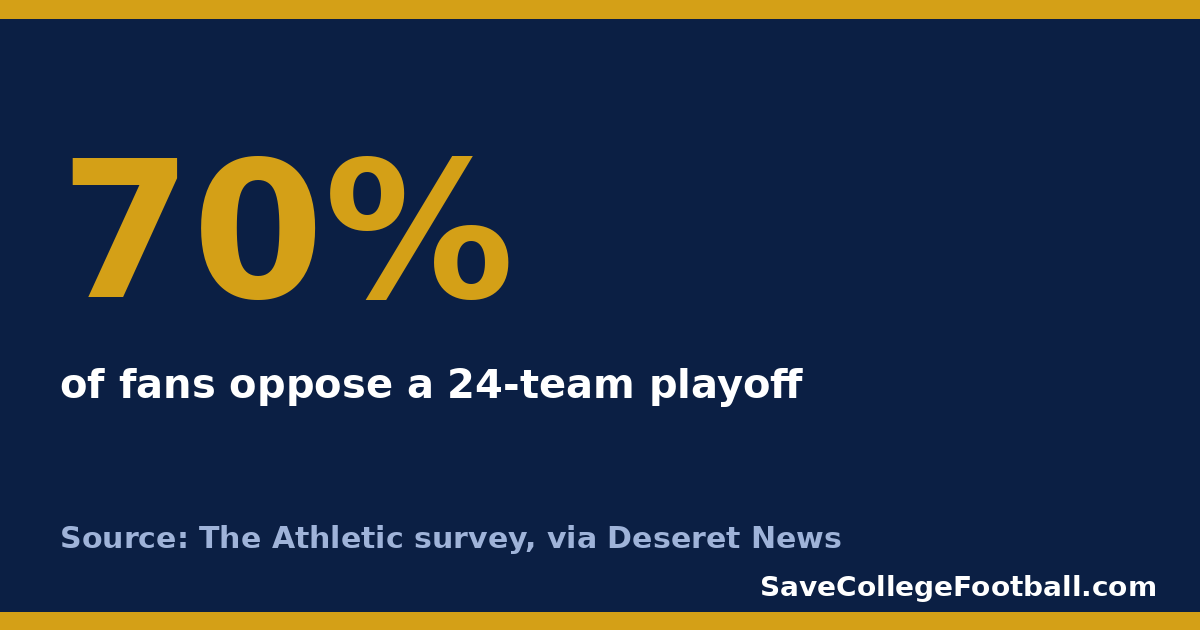
    Fans have already spoken. The Athletic’s survey found roughly 70% of fans oppose a 24-team playoff, as reported by Deseret News. With a reported Dec. 1 decision deadline looming, now is the time to be loud.

    Keep it at 12. Take action here.

    If tonight’s rankings got your blood pumping, share this post with a friend who still screams at the TV every November. Let’s keep it that way. #SaveCollegeFootball

  • Halloween Saturday Proved Exactly What a 24-Team Playoff Would Destroy

    If you want to know what college football tastes like when it is still alive, you had to be watching yesterday.
    You had to feel the air go out of the Los Angeles Memorial Coliseum—and then roar back to life—as unranked USC dragged No. 2 Ohio State into the deep water and stunned the Buckeyes, 30-18. You had to see the faces in Ames, where Iowa State and No. 24 Oklahoma State traded haymakers until the scoreboard read 51-49, and a two-point margin felt like the difference between heaven and earth. You had to watch No. 1 Miami staring into the abyss in Chapel Hill, needing a fourth-quarter touchdown drive with 2:33 on the clock just to survive a 4-4 North Carolina team, 38-35.
    From Syracuse pulling off a last-second 30-27 stunner over No. 19 SMU with 17 seconds left, to Iowa blanking No. 25 Wisconsin 30-0, to Oregon knocking off No. 20 Northwestern 34-26 in Eugene, six ranked teams walked off the field yesterday with their seasons forever altered. Even No. 4 Indiana needed overtime just to escape Minnesota, 23-16.
    It was chaotic. It was heartbreaking. It was glorious. And if the television executives pushing a 24-team College Football Playoff get their way, a Saturday like yesterday will never feel the same again.
    Think about what USC’s 30-18 upset over Ohio State actually meant last night. The Buckeyes outgained the Trojans by more than 100 yards, held the ball for nearly 40 minutes, and still got punched in the mouth by a team playing like its hair was on fire. With that loss, Ohio State dropped to 6-2. In a real college football season, a second loss on Halloween night is an earthquake. It puts your season on a razor’s edge. It makes every single snap in November a sudden-death referendum on your team’s soul.
    Now, imagine that exact same fourth quarter in Los Angeles under a 24-team playoff.
    In a 24-team format, a 6-2 Ohio State doesn’t walk off the Coliseum turf in stunned silence. They shrug. Why wouldn’t they? Even with a third or fourth loss, a blue-blood roster is virtually guaranteed to finish inside the top 24. Instead of a program-defining upset that shakes the sport to its foundation, USC’s triumph is reduced to an exhibition game that nudges Ohio State from a projected first-round bye down to hosting a home game as the No. 11 seed.
    What about Chapel Hill? When Darian Mensah found Malachi Toney with 2:33 left to save No. 1 Miami’s undefeated season, hurricanes of relief swept through South Florida while heartbreak settled over Kenan Stadium. That tension existed because perfection is fragile, and the margin matters. What about Ames, or Syracuse, or Iowa City? Oklahoma State (now 5-3), SMU (6-2), Northwestern (6-2), Arizona (6-2), and Wisconsin (5-3) all suffered gut-wrenching defeats yesterday. Today, those locker rooms are hurting because losing is supposed to hurt.
    Under a 24-team bloated bracket, three-loss and four-loss power conference teams don’t mourn in November—they just wait for their participation trophy seeding in December. Even worse, the current 24-team blueprint being shopped by network executives would scrap conference championship weekend entirely to clear the calendar for more first-round television inventory. Years of regional pageantry, trophy presentations, and conference races—flushed away so 8-4 teams can get blown out by 20 points before Christmas.
    We don’t love college football because it is a sterile, six-week tournament in December where half the league gets a ticket. We already have the NFL for that. We love college football because on a crisp October night, a four-loss North Carolina team can make the No. 1 team in America sweat bullets. We love it because a stadium full of college kids can storm the field knowing they just ruined a rival’s dream.
    Yesterday gave us everything this sport was built on: desperation, consequence, and unscripted magic. Don’t let the people in boardrooms tell you that taking the stakes out of Saturday is “progress”.
    The December 1 deadline for the 2027–28 playoff format is one month away. If yesterday meant anything to you, help us protect it.

  • Why November College Football Shouldn’t Feel Like the NBA Regular Season

    As the calendar flips to November, college football enters the stretch that separates it from every other sport in America. Every Saturday from here to Rivalry Week is supposed to be survival football: lose once, and your conference title or playoff hopes hang by a thread; lose twice, and your season’s championship dream is over.

    Under the proposed 24-team College Football Playoff, November loses its teeth.

    When two dozen teams make the postseason bracket, a 10–2 or 9–3 power conference team doesn’t sweat a November road trip—they simply rest starters, manage snap counts, and wait for their seed. That works fine for an 82-game NBA season or a 162-game baseball schedule. It is fatal to a 12-game college football season built on weekly urgency, packed stadiums, and generational rivalries.

    With the reported December 1 deadline for 2027–28 CFP format changes just one month away, fans have a narrow window to push back. Share our Take Action page, tag your athletic director, and tell decision-makers: Keep November elimination football. Say no to 24 teams.

  • Why a 24-Team Playoff Would Hurt College Football

    Why a 24-Team Playoff Would Hurt College Football

    College football has always been different from other sports. Every Saturday in the fall carries weight because every game counts. A proposed 24-team College Football Playoff threatens that, and fans are saying so loudly.

    The regular season is the heart of the sport

    The magic of college football is that a single loss can change a season. Rivalry games, conference showdowns and late-season trips carry real stakes because there is so much on the line. When two dozen teams qualify for a postseason bracket, those stakes shrink. A game that once decided a season could become little more than a seeding exercise, and the urgency that brings fans to stadiums and keeps them glued to their televisions begins to fade.

    Fans are not asking for this

    The numbers are not close. The Athletic survey found 70% of fans oppose a 24-team playoff, while 30% support it, according to Deseret News. An April On3 social poll found 79% of respondents prefer 12 or 16 teams, and only 9% want 24, as noted by Awful Announcing. That poll was non-scientific, so it should be read as a signal rather than a precise measurement, but the direction matches the survey: fans are not clamoring for a bigger bracket.

    Despite this, Tony Petitti has dismissed the polls and the fan backlash. In his words: “I’m really confident that we’ll fill our stadiums and we’ll have really large audiences for these games.” Filling stadiums and drawing audiences is not the same as listening to the people who make up those crowds.

    More games, more blowouts

    Supporters of expansion say a larger field means more excitement. The recent evidence points the other way. According to Newsweek, over half of last year’s playoff games had double-digit blowouts. If the existing format already produces so many lopsided results, adding more teams to the bracket is unlikely to make the games more competitive. It is likelier to add more mismatches.

    Workload, safety and the money

    A larger playoff also means more games added to a long season for the athletes who play them. Every extra game asks more of players’ bodies and schedules, and that deserves serious consideration before any decision is made. Meanwhile, more playoff games means more television inventory, and it is fair for fans to ask whether the push for 24 teams is about what is best for the game or about the money.

    The clock is ticking

    A Dec. 1 deadline has been reported for format changes for the 2027-28 season. That leaves little time for fans to be heard.

    What you can do

    Fans built this sport, and fans can still shape its future. Read the full case against a 24-team playoff, then take action: share the site, contact your school, your conference and the College Football Playoff, and use the hashtag #SaveCollegeFootball. Let’s make every Saturday count.